Company Profile
About UsCareers
Job OpeningsHead Office
Gedung Pegadaian Kenari Lantai 4
Jl. Salemba Raya No.2, Kel. Kenari,
Kec. Senen, Kota Jakarta Pusat 10430
Copyright © 2026 PT Pesonna Optima Jasa. All Rights Reserved.
Follow Us
Gedung Pegadaian Kenari Lantai 4
Jl. Salemba Raya No.2, Kel. Kenari,
Kec. Senen, Kota Jakarta Pusat 10430
 November 23, 2026
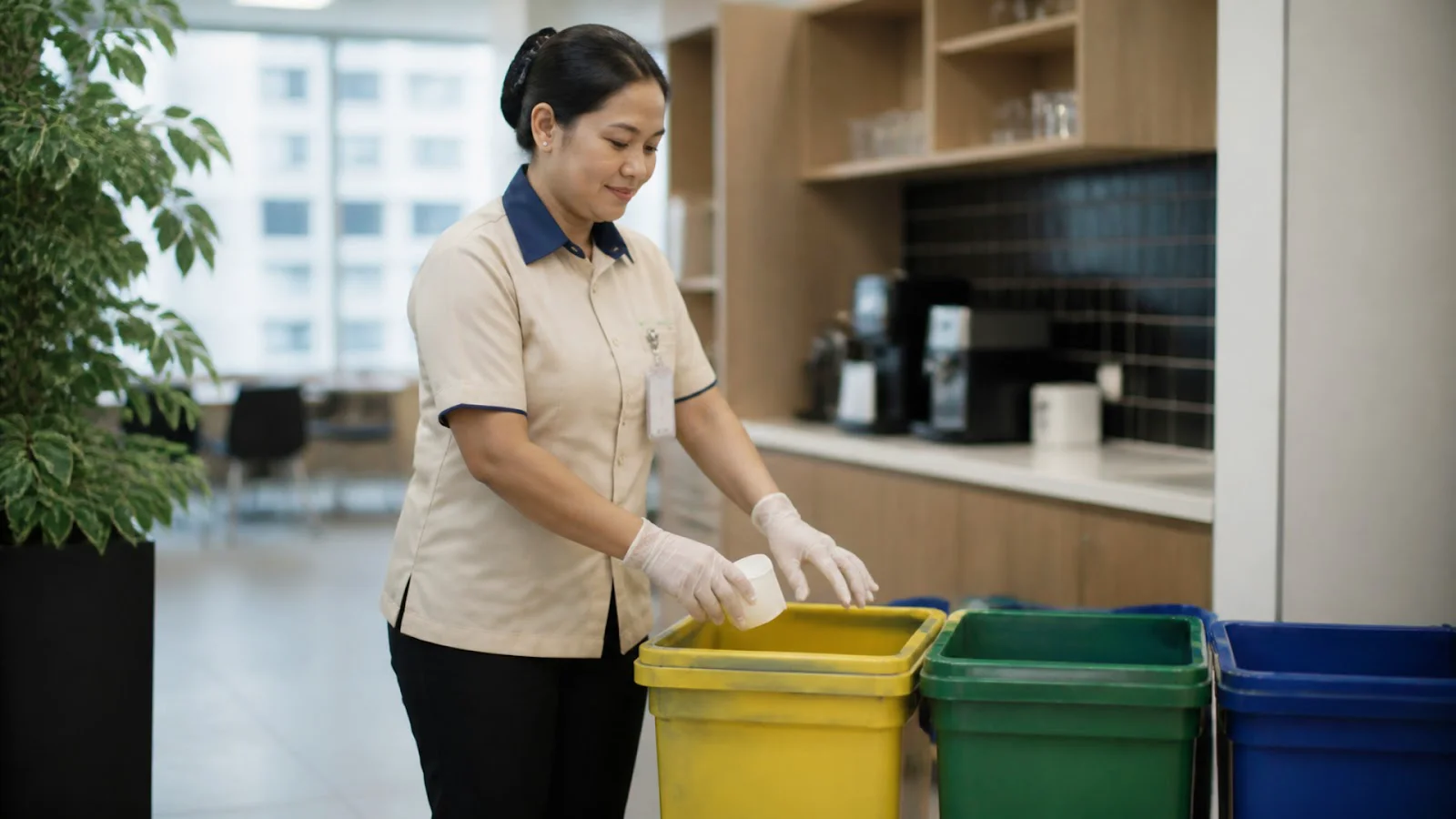
Every 21 February, Indonesia marks National Waste Awareness Day (HPSN) as a reminder of the urgency of managing waste at its source. For modern corporations, state-owned enterprises and public companies, waste management is no longer a one-off CSR activity but an important indicator for Environmental, Social and Governance (ESG) targets and Sustainability Reports.
The success of carbon and waste reduction strategies in offices depends on waste segregation on the work floor. Without disciplined daily execution by the building cleaning team, a company's green policy stays on paper.
Based on data from the Ministry of Environment and Forestry (KLHK) and global sustainability reporting standards, waste management in commercial areas directly affects a company's environmental performance.
• Average waste per employee (0.5 to 0.7 kg per day): per KLHK's National Waste Management Information System (SIPSN), offices and commercial areas generate an average of 0.5 to 0.7 kg of waste per person per day. Office waste is typically dominated by paper and cardboard (40% to 50%), food and organic waste from pantries (25% to 35%) and plastic packaging and cans (15% to 20%).
• Landfill diversion potential (waste diversion rate 60% to 75%): sustainable facility management shows at-source segregation can divert 60% to 75% of office waste to recycling and composting, significantly reducing methane (CH₄) emissions at landfills counted in a company's indirect Scope 3 carbon inventory.
• Sustainability reporting obligations in Indonesia: under POJK No. 51/POJK.03/2017 on Sustainable Finance and the GRI 306 (Waste) standard, issuers, financial institutions and large companies must disclose quantitative data on waste weight, segregation methods and the percentage recycled each year.
• Legal mandate for area waste management: under Government Regulation No. 81 of 2012, managers of commercial, office and industrial areas must provide integrated waste sorting facilities and efforts to limit and recycle waste.
ESG highlight: in green building certification audits (Greenship GBCI or LEED) and ISO 14001 environmental management systems, waste sorting infrastructure and daily waste volume records are mandatory scoring points.
To make recycling effective and avoid cross-contamination, office waste segregation is ideally divided into four categories.
Includes employee food scraps from pantries and canteens, coffee or tea grounds, wet food tissue and plant trimmings from building gardens. Separating organic waste keeps food liquid from soiling paper and plastic and opens the way to compost or eco-enzyme processing.
Includes used printer paper, logistics cardboard, PET plastic bottles, aluminum drink cans and glass containers. Cleaning staff make sure drink packaging is empty and cardboard is folded before moving it to the building's temporary storage (TPS).
Includes used office device batteries, dead fluorescent tubes, used printer cartridges or toner, pressurized aerosol cans and empty cleaning chemical containers. These must be separated into special labeled containers so they do not pollute the environment or endanger waste collectors.
Plastic-aluminum laminated packaging (sachets), styrofoam and toilet sanitary waste go to final disposal as residue. Physical documents with sensitive company data must be shredded before being handed to a paper recycling partner.
Waste segregation policies often fail in the field because waste sorted by employees is mixed again during collection. This is where trained cleaning staff play a strategic role in supporting company ESG targets.
• Maintaining two-tier segregation consistency: staff use color-coded liners matching bin categories so segregation is kept from the work floor and collection trolley to the building's TPS room.
• Weighing and daily waste logbook: the field coordinator (team leader) weighs each waste category in kilograms before handing it to the area manager or partner waste bank. This data is valuable audit evidence for Sustainability and GA teams preparing the annual ESG report.
• Drop-box hygiene maintenance: staff regularly clean and disinfect bins in pantries and the centralized recycling station to keep them free of odors and pests.
Integrating waste segregation into daily building routines needs people who understand environmental SOPs and neat reporting standards. You can optimize your building's sustainability initiatives with a cleaning service that has strong environmental governance. PT Pesonna Optima Jasa manages more than 1,400 trained cleaning staff across Indonesia under the Quality, Occupational Health and Safety, Environment and Anti-Bribery (MK3L-AP) policy. Besides structured waste sorting procedures and eco-friendly cleaning chemicals, its operations team supports ISO 14001 compliance and sustainability targets at every company facility. To learn more, visit the official Optimajasa Cleaning Service page:
• How do we effectively start waste sorting in an office that used a single bin? The most effective step is removing personal deskside bins and replacing them with centralized recycling stations in pantries and main corridors. This improves employee discipline and makes it easier for cleaners to monitor sorting.
• Can the cleaning service team provide monthly waste volume reports for ESG needs? Yes, with SOPs agreed at the start of the contract, the team leader can record daily waste weight by category (organic, recyclable inorganic and residual) in a monthly recap report for GA or Sustainability teams.
• What are the standards for handling light B3 waste such as used fluorescent tubes or chemical bottles? Cleaning staff trained in K3 and environment separate light B3 waste into closed, specially labeled containers in a separate storage room before handing it to the building manager or a licensed third-party B3 waste transporter.
• Law of the Republic of Indonesia No. 18 of 2008 on Waste Management.
• Government Regulation No. 81 of 2012 on Household Waste and Household-Like Waste Management.
• KLHK: SIPSN and National Waste Awareness Day (HPSN) guidelines.
• OJK Regulation No. 51/POJK.03/2017 on Sustainable Finance.
• GRI Standards: GRI 306 Waste Disclosures and ISO 14001:2015 Environmental Management Systems.
Gedung Pegadaian Kenari Lantai 4
Jl. Salemba Raya No.2, Kel. Kenari,
Kec. Senen, Kota Jakarta Pusat 10430
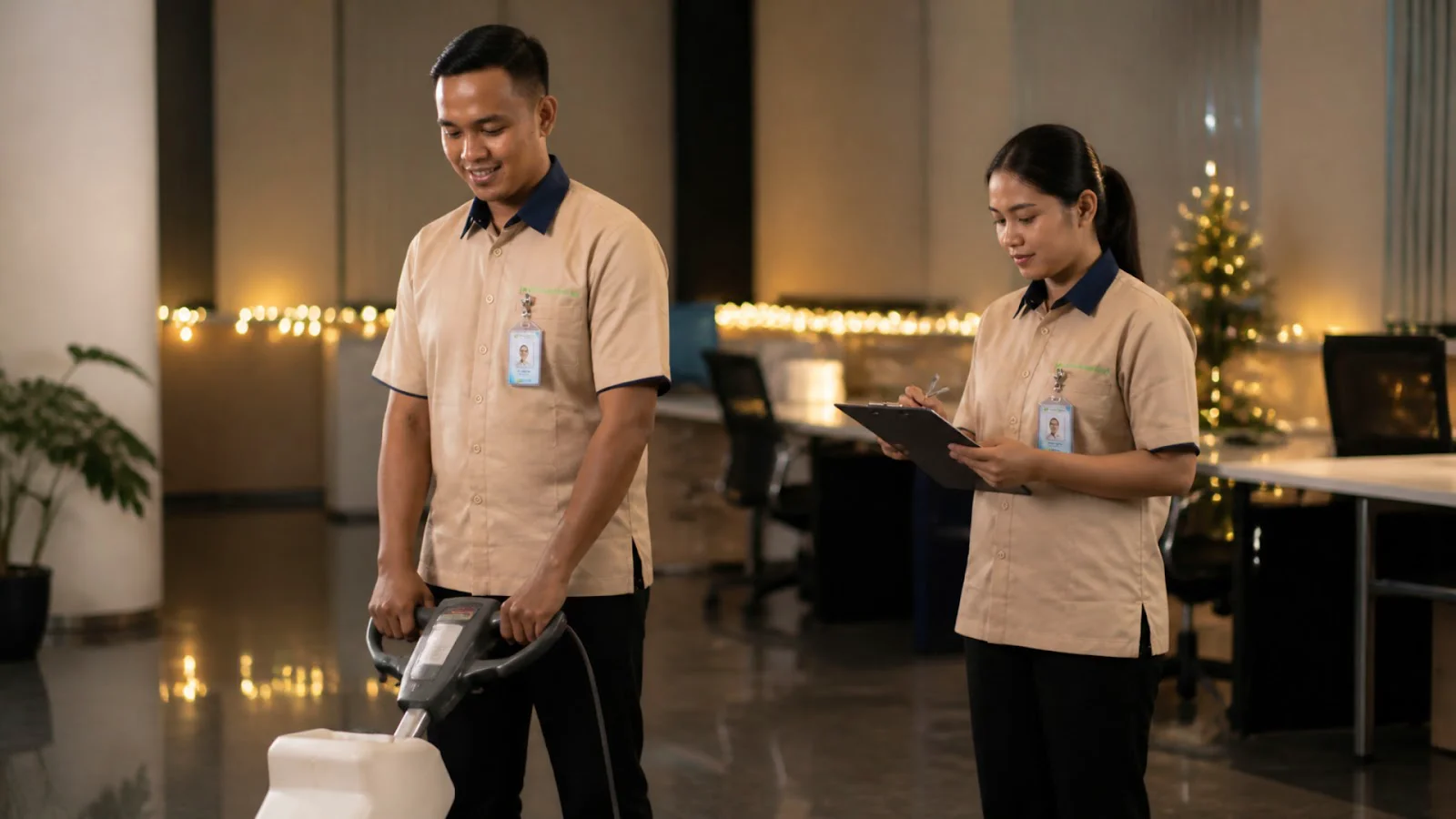
Deep cleaning protocol and cleaning shift management during the year-end holiday: critical building cleaning points and standby staff scheduling.
November 23, 2026