Company Profile
About UsCareers
Job OpeningsHead Office
Gedung Pegadaian Kenari Lantai 4
Jl. Salemba Raya No.2, Kel. Kenari,
Kec. Senen, Kota Jakarta Pusat 10430
Copyright © 2026 PT Pesonna Optima Jasa. All Rights Reserved.
Follow Us
Gedung Pegadaian Kenari Lantai 4
Jl. Salemba Raya No.2, Kel. Kenari,
Kec. Senen, Kota Jakarta Pusat 10430
 November 23, 2026

For General Affairs (GA), Human Resources (HR) and Procurement teams, choosing how to manage cleaning staff is often a dilemma. On paper, hiring cleaners in-house looks cheaper because only the monthly base salary is counted. But this calculation often ignores hidden costs. To find out which is really more efficient, let us break down the cost structure of in-house versus outsourced company cleaning staff.
When a company manages its own cleaning staff, the costs go far beyond monthly wages (regional minimum wage). Here is the list of expenses to account for.
• Recruitment and basic training costs: budgets for job ads, interviews, background screening and standard training in cleanliness, occupational safety (K3) and hospitality.
• Social security and allowances: besides base pay, the company must cover BPJS Employment and BPJS Health contributions, holiday allowance (THR) and overtime pay when staff work on holidays.
• Severance and employment rights: if employment ends or staff retire, the company must prepare severance and other labor rights under applicable regulations.
• Chemicals and work equipment: in-house forces the GA team to regularly buy cleaning chemicals, mops, vacuum cleaners and large machines such as floor polishers. Besides purchase cost (CapEx), machine maintenance costs often balloon when equipment breaks.
• Uniforms and PPE: annual work uniforms, special shoes (safety shoes or boots), raincoats and other personal protective equipment such as rubber gloves and masks.
• Opportunity cost when staff are absent: when in-house staff are sick or on leave, work areas are neglected, and internal teams often scramble for freelance daily replacements, costing time and extra money.
Moving to outsourcing turns fluctuating capital spending and unexpected costs into stable, predictable operating costs.
• Flat rate cost system: with outsourcing you pay one fixed invoice monthly, generally covering staff wages, BPJS, THR, area management, work equipment and chemicals. No more surprise costs mid-year.
• Guaranteed replacement staff (back-up or reliever): if staff are sick, on leave or resign, the vendor automatically sends a replacement under reliever SOP at no extra cost, so your areas stay 100% clean every day.
• Employment risk transfer: employment contracts, industrial relations disputes and severance payments become the vendor's responsibility, not yours.
• Focus on core business: HR and GA teams no longer spend hours on running out of mop soap or broken vacuums, and can focus on developing the main business.
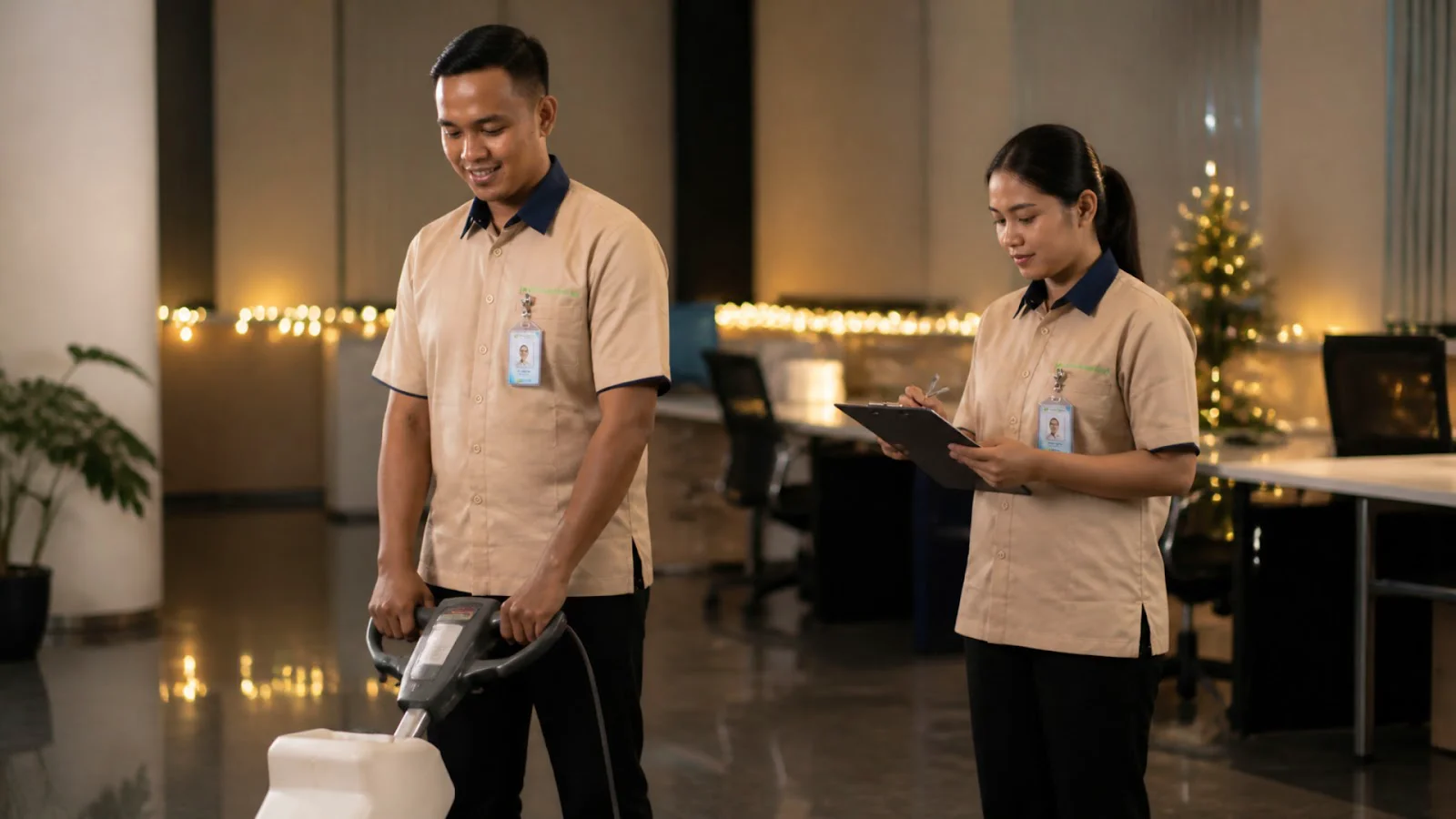
Moving to outsourcing is a very efficient decision, provided you partner with a facility management company with national capability and transparent governance. To keep your building hygiene standard at a rational cost, you can use the cleaning service from PT Pesonna Optima Jasa.
With a portfolio of more than 1,400 cleaning staff across Indonesia, Optimajasa offers an efficient, transparent cost structure and peace of mind for clients. All operations run under Quality, Occupational Health and Safety and Environmental (MK3L) compliance standards, ensuring company assets are cared for by reliable, certified and regulation-protected personnel. To learn more, visit the official Optimajasa Cleaning Service page:

Gedung Pegadaian Kenari Lantai 4
Jl. Salemba Raya No.2, Kel. Kenari,
Kec. Senen, Kota Jakarta Pusat 10430
Sanitation standards for musholla, pantries and public office facilities during Ramadan: protocols, shift strategy, FAQ and a daily checklist.
November 23, 2026