Company Profile
About UsCareers
Job OpeningsHead Office
Gedung Pegadaian Kenari Lantai 4
Jl. Salemba Raya No.2, Kel. Kenari,
Kec. Senen, Kota Jakarta Pusat 10430
Copyright © 2026 PT Pesonna Optima Jasa. All Rights Reserved.
Follow Us
Gedung Pegadaian Kenari Lantai 4
Jl. Salemba Raya No.2, Kel. Kenari,
Kec. Senen, Kota Jakarta Pusat 10430
 November 23, 2026
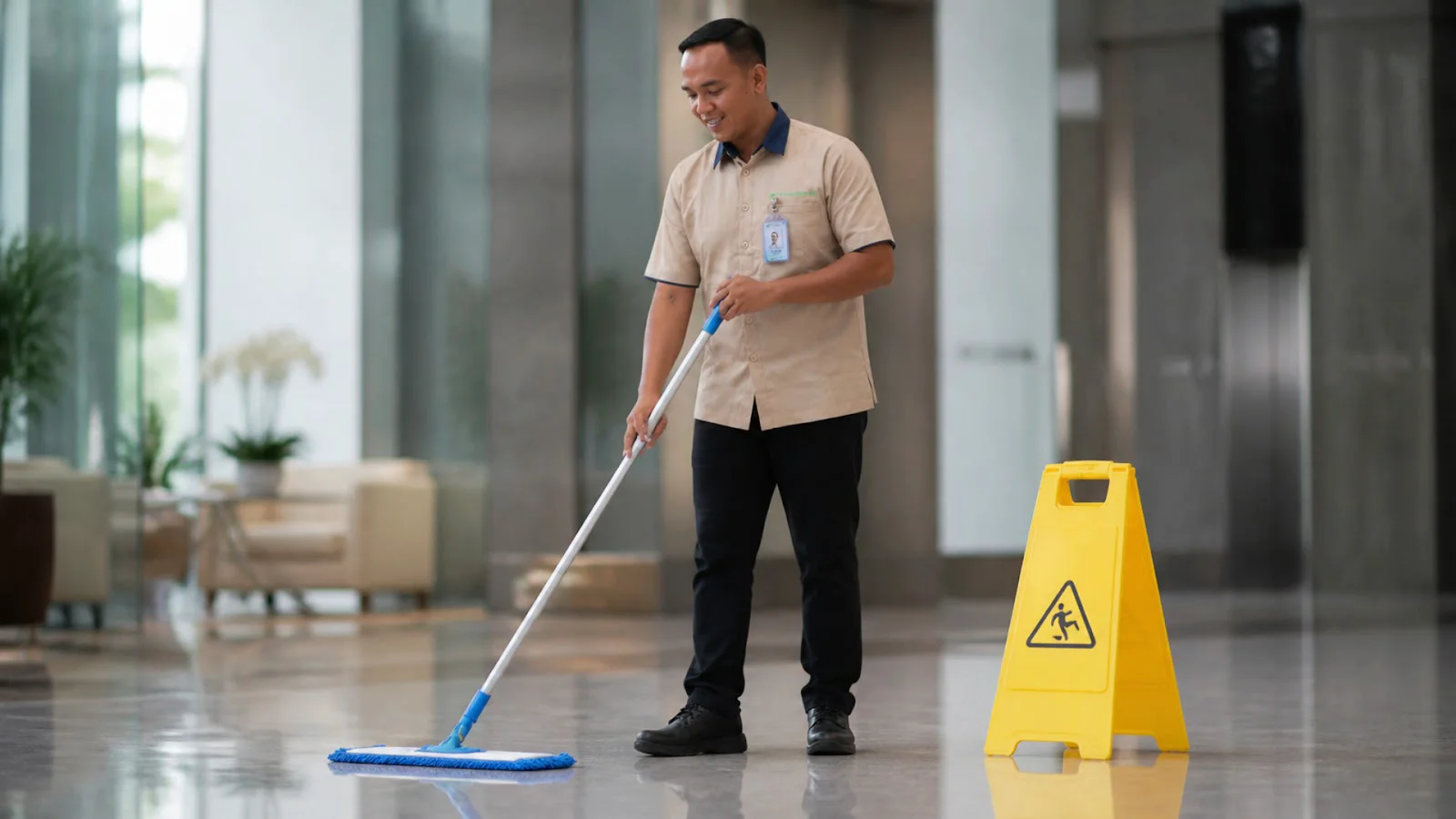
Every year from 12 January to 12 February, companies across Indonesia mark National Occupational Safety and Health (K3) Month to strengthen the safety culture in operations. In practice, K3 discussion often focuses on production teams, building technicians or security. Yet cleaning staff are the front line in preventing daily workplace accidents in offices, factories and public facilities.
Building cleanliness is not only about looking tidy; it is an integral part of workplace safety risk management regulated by labor rules. Without cleaning procedures that meet K3 standards, routine cleaning can itself create new hazards for employees and visitors.
Global safety authorities and national regulations treat housekeeping and workplace sanitation as a deciding factor in reducing accidents and occupational disease.
• Slips, trips and falls (20% to 30% of non-fatal workplace accidents): according to OSHA and National Safety Council data, slips, trips and falls account for roughly 20% to 30% of non-fatal work injuries in commercial and industrial sectors, mostly from wet floors after mopping without warning signs, slow response to spills or cleaning equipment cables across walkways.
• Productivity loss from Sick Building Syndrome (10% to 15%): WHO and U.S. EPA studies on indoor air quality show dust in AC vents, damp carpets that breed mold spores and cleaning chemical fumes can trigger Sick Building Syndrome, cutting productivity by 10% to 15% through headaches, respiratory irritation and fatigue.
• Legal K3 obligations in Indonesia: under Minister of Manpower Regulation No. 5 of 2018 on Occupational Safety and Health in the Work Environment, company management must meet workplace K3 requirements covering chemical and biological factors, hygiene standards, facility sanitation and good housekeeping that is clean, tidy and hazard-free.
• Preventing accidents in operational areas: per the Ministry of Manpower's supervision agenda and BPJS Employment accident claim data, strengthening a preventive culture across all lines, including facility support staff, is key to lowering accident rates in buildings and industrial areas.
Important K3 note: under international safety management standards such as ISO 45001, good housekeeping is the most basic indicator of a company's K3 culture discipline.
To keep building operations accident-free (zero accident), professional cleaning staff carry out five key roles.
Staff must place wet floor signs in clearly visible spots before mopping, use measured damp mopping so water does not pool, and respond quickly (under 5 to 10 minutes) to water or oil spills in high-traffic areas such as lobbies and pantries.
In line with the Globally Harmonized System (GHS) and Ministry of Manpower rules on chemical factors, trained staff must understand SDS or MSDS, make sure every spray bottle has a clear label, use manufacturer dilution ratios and store chemicals in a well-ventilated special storeroom.
During daily inspection, cleaners make sure emergency stairs, exits and access to fire extinguishers and hydrants are free of cardboard, bins and equipment trolleys that could block evacuation.
Staff separate domestic waste from light hazardous and toxic (B3) waste common in offices, such as broken fluorescent tubes, used batteries, pressurized aerosol cans and empty chemical containers, so they are not mixed and do not endanger waste collectors.
For risky tasks such as cleaning interior glass, high dusting ceilings or toilet sanitation, staff must wear complete PPE: non-slip shoes, chemical-resistant gloves, respirator masks and full body harness when using ladders or scaffolding.
National K3 Month is a good moment for General Affairs (GA) and Health, Safety and Environment (HSE) teams to evaluate building cleaning operations with this checklist.
• Have all cleaning staff received K3 induction and basic training before starting work in the building?
• Is a Safety Data Sheet (SDS) available for every cleaning chemical stored in the janitor room?
• Is staff PPE (non-slip shoes, rubber gloves, masks) in usable condition and regularly replaced?
• Are polisher or vacuum cleaner cables checked regularly to prevent short circuits in damp areas?
• Is public area cleaning scheduled outside peak hours to minimize collision or tripping risk?
A consistent K3 culture in cleaning operations needs structured training and strict daily field supervision. Handing this responsibility to a cleaning service provider with proven safety governance eases the supervision burden on your GA and HSE teams. PT Pesonna Optima Jasa manages more than 1,400 professional cleaning staff across Indonesia, all under the commitment of the Quality, Occupational Health and Safety, Environment and Anti-Bribery (MK3L-AP) policy. From mandatory K3 training before placement, standard PPE and eco-friendly chemicals safe for health to periodic area supervision, Optimajasa ensures your workplace is not only visually clean but also safe and compliant. To learn more, visit the official Optimajasa Cleaning Service page:
• Are cleaners from outsourcing vendors trained in K3 before placement? Yes, professional outsourcing providers must give basic safety induction, chemical handling training and PPE use to every staff member before deployment to the client site.
• Who provides PPE and safety signs such as wet floor signs? Under a full package contract, all PPE, wet floor signs and standard K3 work equipment are provided by the vendor as part of operational facilities.
• What are the safety standards for cleaning at height (high dusting)? Cleaning at height may only be done by staff who understand working at height procedures, use stable aids such as scaffolding or safety-standard ladders and are supervised by a field coordinator (team leader).
• Law of the Republic of Indonesia No. 1 of 1970 on Work Safety.
• Minister of Manpower Regulation No. 5 of 2018 on Occupational Safety and Health in the Work Environment.
• Ministry of Manpower: Guidelines for National K3 Month implementation.
• OSHA: Walking-Working Surfaces and Slips, Trips and Falls Prevention Standards.
• WHO and U.S. EPA: Indoor Air Quality and Sick Building Syndrome Fact Sheets.
Gedung Pegadaian Kenari Lantai 4
Jl. Salemba Raya No.2, Kel. Kenari,
Kec. Senen, Kota Jakarta Pusat 10430
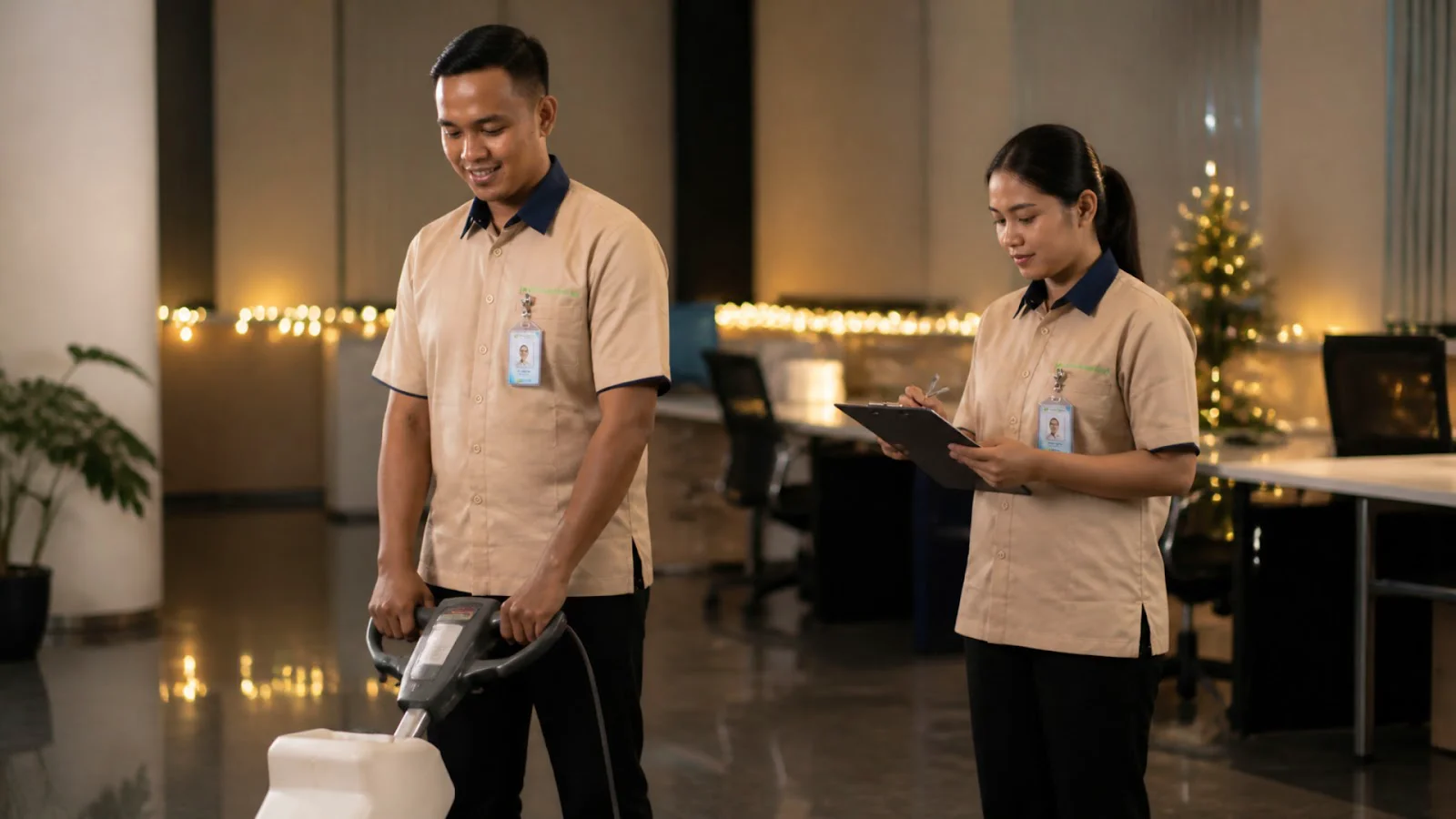
Deep cleaning protocol and cleaning shift management during the year-end holiday: critical building cleaning points and standby staff scheduling.
November 23, 2026