Company Profile
About UsCareers
Job OpeningsHead Office
Gedung Pegadaian Kenari Lantai 4
Jl. Salemba Raya No.2, Kel. Kenari,
Kec. Senen, Kota Jakarta Pusat 10430
Copyright © 2026 PT Pesonna Optima Jasa. All Rights Reserved.
Follow Us
Gedung Pegadaian Kenari Lantai 4
Jl. Salemba Raya No.2, Kel. Kenari,
Kec. Senen, Kota Jakarta Pusat 10430
 November 23, 2026
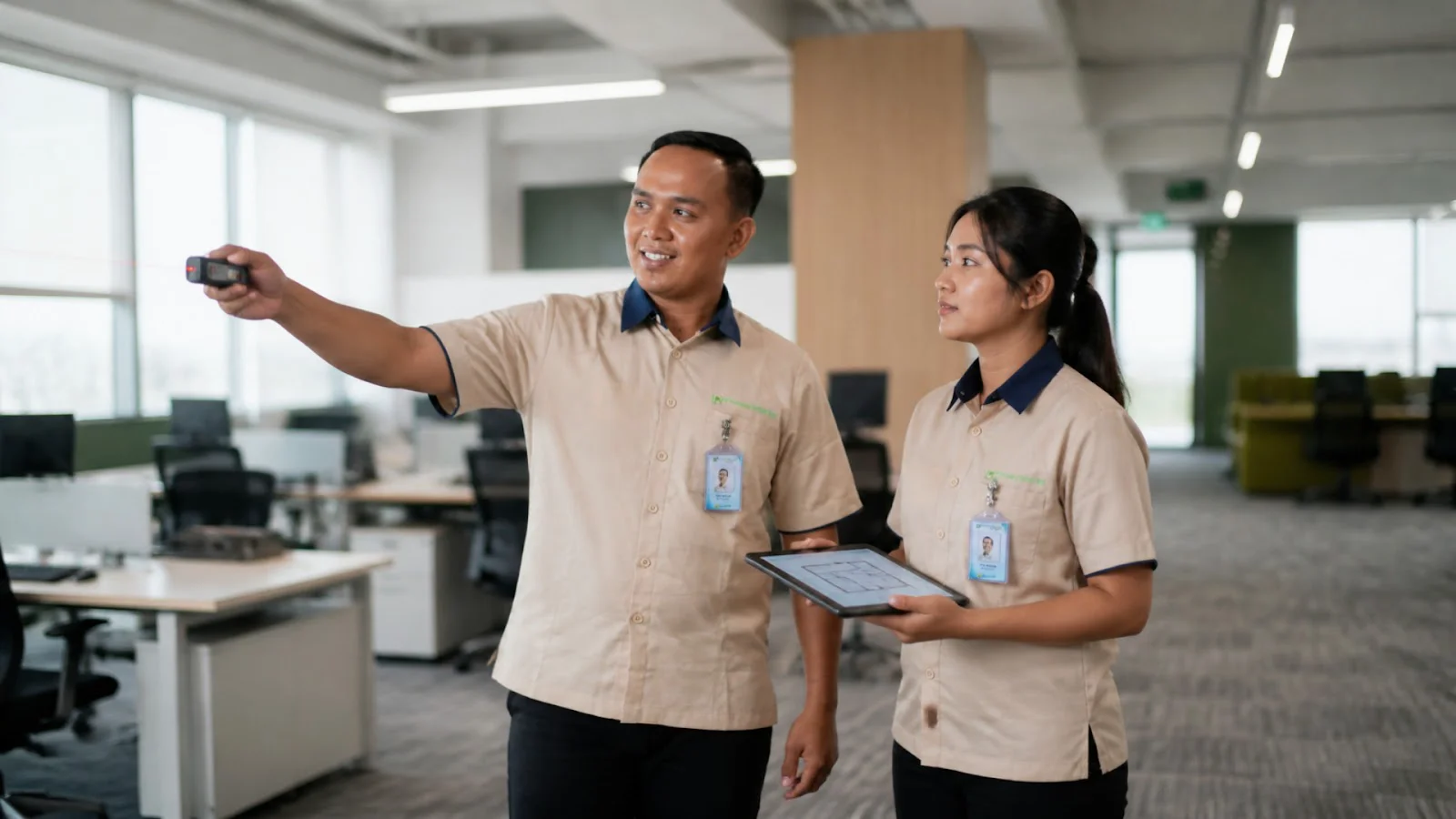
Determining the ideal number of cleaning staff is often a challenge for General Affairs (GA) and Procurement teams when preparing budget plans (RAB) or tender documents. Too few staff means overwork, falling hygiene standards and faster dulling of building assets. Too many causes budget bloat.
To allocate budget accurately, staffing needs should not rest on guesses but on the cleaning production rate per square meter (m²), adjusted to building characteristics.
Following international facility management standards such as ISSA (The Worldwide Cleaning Industry Association) and IFMA, one cleaner in a normal 8-hour shift (about 6.5 to 7 hours of effective cleaning) covers different areas depending on traffic density.
• Standard corporate office: 1 cleaner per 1,200 to 1,500 m². Traffic is predictable (busy in the morning, lunch and afternoon) with mostly closed workspaces, meeting rooms and tile or carpet floors.
• Banking and public service areas (high traffic): 1 cleaner per 800 to 1,000 m². High customer mobility needs re-cleaning (policing) every 30 to 60 minutes in lobbies, waiting rooms, ATM areas and public toilets.
• Educational institutions (campuses and schools): 1 cleaner per 1,000 to 1,300 m². Dense student activity at class changes needs extra readiness in corridors, stairs, canteens and shared sanitation.
• Factories, warehouses and industrial estates: 1 cleaner per 2,000 to 3,000 m² for open warehouses supported by scrubber machines. For factory offices, canteens and locker rooms the ratio returns to 800 to 1,000 m² per cleaner.
• Healthcare facilities and clinics (high hygiene): 1 cleaner per 500 to 750 m². These areas need layered disinfection protocols, strict waste sorting and repeated cleaning to prevent cross-contamination.
Facility management rule of thumb: if a building needs more than 5 to 6 operational staff in one shift, add 1 Team Leader (field supervisor) outside the area quota so quality control and task division run optimally.
To get a baseline before a site survey, use this formula.
Basic formula: Number of Staff = (Total Cleanable Area ÷ Sector Productivity Ratio) × Number of Operating Shifts.
Suppose your company manages a 5-floor office building with 6,000 m² of cleanable area operating one normal shift. Using the standard office ratio of 1,200 m² per cleaner, the basic calculation is 6,000 m² ÷ 1,200 m² = 5 operational staff (ideally 1 per floor). Since there are 5 staff, add 1 Team Leader to run daily inspection, manage chemical stock and coordinate with the GA team. The total ideal need is 6 personnel.
Building area is only a starting point. In professional practice the formula result must be adjusted for four field variables.
A 5,000 m² building with 150 employees has a very different cleaning load from the same size with 600 employees. The denser the ratio of users to toilets and pantries, the more staff must stand by in wet areas.
Marble, granite or terrazzo floors need periodic polishing and crystallization to avoid dulling, taking longer than standard ceramic or vinyl floors. The same goes for the interior glass partitions common in modern offices.
Modern machines such as auto-scrubbers or ride-on sweepers in large lobbies and basement parking can raise one cleaner's productivity two to three times versus manual mopping.
Facilities operating 16 to 24 hours (customer service offices, three-shift factories or data centers) need morning, afternoon and night shifts with staff composition adjusted for peak hours.
Mapping area, calculating productivity ratios and choosing cleaning machine specifications takes technical experience so the proposed budget is truly efficient. Instead of guessing, consult an experienced cleaning service provider for a facility survey. PT Pesonna Optima Jasa manages more than 1,400 professional cleaning staff across Indonesia, and its operations team assesses building area, floor materials, daily traffic and Quality, Occupational Health and Safety, Environment and Anti-Bribery (MK3L-AP) compliance to compose the most optimal staffing and cost proposal. To learn more, visit the official Optimajasa Cleaning Service page:
• Does the calculated area include outdoor parking and gardens? Not always. The ratios focus on cleanable indoor area (workspaces, lobbies, corridors, stairs, toilets and pantries). Outdoor parking, landscaping or high-rise glass cleaning (gondola or rope access) use their own productivity standards and specialist teams.
• What if building occupancy changes (for example hybrid work)? With outsourcing, a company can periodically review staff composition as density changes, so the budget stays efficient.
• Will the vendor survey the site before proposing staff numbers? Yes, professional vendors always do a site visit first to measure work zones, check floor materials and sanitation, and make sure the proposed ratio matches the agreed Service Level Agreement (SLA).
• ISSA: The Official ISSA Cleaning Times and Tasks.
• IFMA: Operations and Maintenance Benchmarks Report.
• BOMA: Office Building Cleaning and Maintenance Standards.
• Minister of Health Regulation No. 70 of 2016 on Health Standards and Requirements for Industrial and Office Work Environments.
Gedung Pegadaian Kenari Lantai 4
Jl. Salemba Raya No.2, Kel. Kenari,
Kec. Senen, Kota Jakarta Pusat 10430
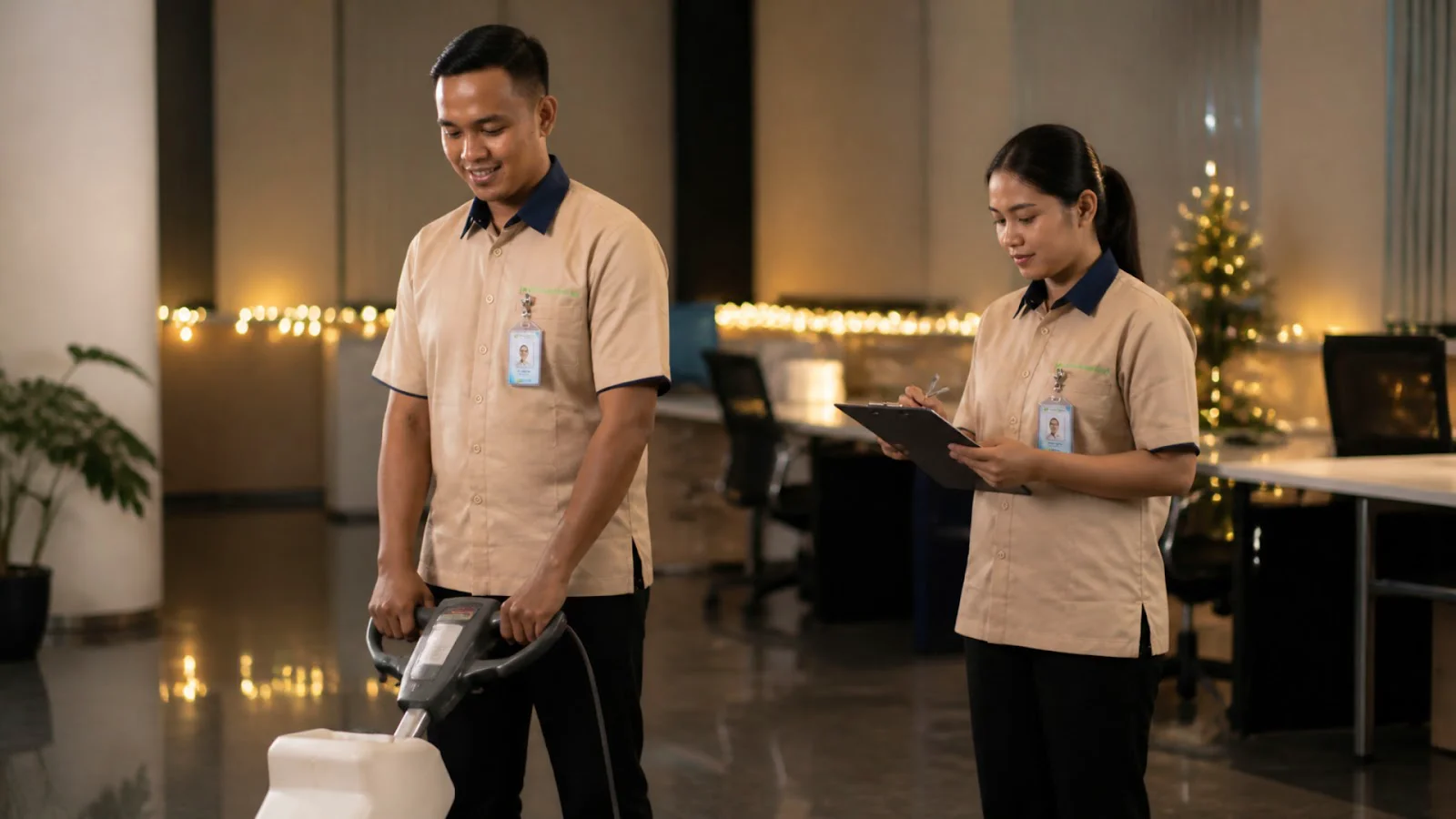
Deep cleaning protocol and cleaning shift management during the year-end holiday: critical building cleaning points and standby staff scheduling.
November 23, 2026